
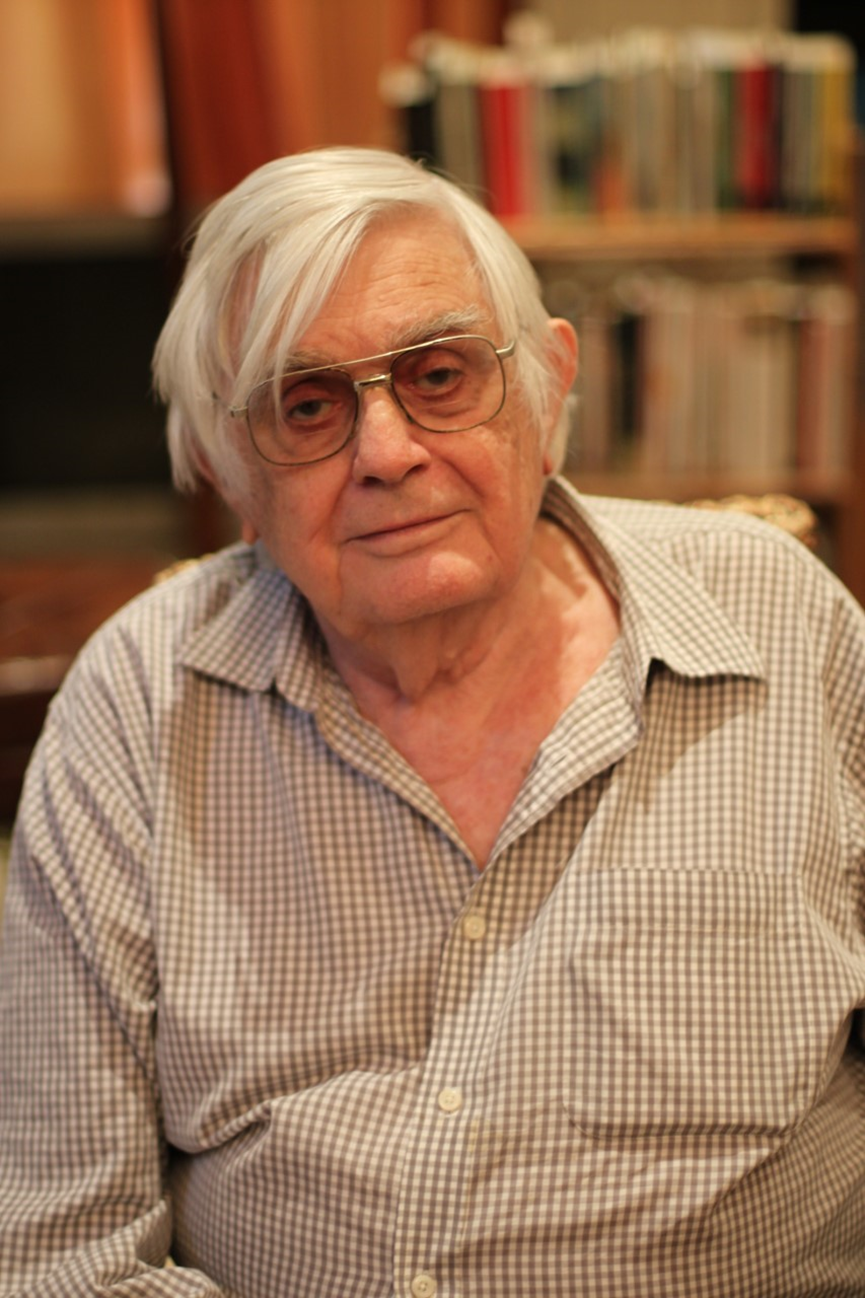
Vale William Grono (1934-2022)
A collection in memoriam of William (Bill) Grono, poet, editor and teacher.
Westerly is grateful to the work of Dennis Haskell in gathering this tribute, and wishes to acknowledge Bill’s family with gratitude for their permission for the use of images and poetry included.
Recollections of Bill Grono
Nicholas Hasluck
Bill Grono was born at Devonleigh Hospital, Cottesloe, Western Australia, in 1934. His school days included a year or so at Perth Boys School in the city. It was here that Bill fought his first battle on behalf of literature, and encountered the depths of indifference to be overcome.
The headmaster of that school had warned his students, in no uncertain manner, that they were not to stray into the city during their lunch hour. Bill wasn’t troubled by this because, being a bookish fellow from an early age, he grew accustomed to spending most of his lunch hour in the nearby State Library. One day, running late on his way back to the school, he was accosted by the irate headmaster and asked to explain himself. When he said he was on his way back from the Library, the headmaster flew into a rage. ‘Don’t you tell lies to me, boy!’ Bill’s protestations were to no avail. The headmaster, it seems, knowing the general habits of his sports-mad larrikin students, couldn’t envisage that one amongst them might actually have gone off to a library.
School days over, Bill went to Claremont Teachers College in the early 1950s. He was then assigned to a single teacher school in the country. This led to his first posting to a remote outback town called Haig, well to the east of Kalgoorlie: one of the tiny settlements scattered along the trans-Nullarbor railway line. Most of the men in the township worked as fettlers on the railway, many of them being Polish immigrants with German wives.
Social life in the town was scant and alcohol hard to come by, unless it was ordered by a social club. Bill claimed to have been instrumental in setting up a tennis club soon after his arrival, followed by the creation of a social club for the holding of dances in the town hall. Beer came from Kalgoorlie, wine from South Australia. This led to a degree of turmoil, apparently, as the volume of drinking escalated and supplies of liquor were heatedly contested. By this time the social scene, like the surrounding desert landscape, had become so bleak that Bill was inclined to leave Haig. He did so after a memorable, but not necessarily enriching, stay of four months, in search of better prospects. He always denied any responsibility for the social mayhem that he seems to have left in his wake. The town of Haig, I gather—like many of the ghost towns further west in the goldfields—is now virtually non-existent. The vestiges of it lie somewhere to the north of Cocklebiddy.
Bill’s dream was to travel overseas to London and live the life of a poet. Lacking money, he had in mind to work his way there as a seaman, but this proved difficult. When he went to the wharves at Fremantle, he was quickly told that he would have to obtain a union ticket. At the union office he was confronted by a union official and was quickly told to ‘f*** off’.
Travel hopes dashed, Bill pressed ahead with his teaching career. It wasn’t long before he was assigned to a school at Donnybrook, a country town to the south of Perth. His continuing commitment to poetry was reflected in his decades-long subscription to London Magazine, a new journal edited by John Lehmann.
From February 1954 onwards, while teaching in the country, Bill only got to Perth in the school holidays. It was about this time that he first met Randolph (‘Mick’) Stow, for they had noticed each other’s poems in The Winthrop Review, among other places. Eventually, Bill received an invitation to call on Mick Stow. According to Bill in latter years:
‘So one day I went to his room above the archway at St George’s College. I suppose I met him four or five times during the next two years, at St George’s or at parties. We got on quite well at that time, but we were not close.’
Curiously, there turned out to be another point of connection between the two youthful poets. In his final year at the Geraldton Primary School, Mick Stow had collaborated with a local girl, Janet MacGregor, on the school magazine. Some years later, Janet attended Claremont Teacher’s College in the year below Bill, and was then posted to Donnybrook, where she and Bill became colleagues, and eventually, a couple. They were married in Perth at St Andrews, a Presbyterian church on the corner of Pier Street and St George’s Terrace, followed by a reception at the Wentworth Hotel on Murray Street. Music was provided by a Hungarian violinist, whose solo performance was perfectly suited to the occasion. Bill and Janet went on to have three fine children: Miriam, Jane and John.
Bill and Janet served the Education Department in several locations, including a substantial period in Kalgoorlie where they were active in the local dramatic society. Bill continued to write and publish poetry throughout this period, and while doing so, kept in touch with Mick Stow and writers associated with the WA Fellowship of Writers, such as Dorothy Hewett and her partner, Merv Lilley.
I recall being present one evening in mid-1964, when some local poets gave a reading at the old Dolphin Theatre on the UWA campus. In addition to Dorothy Hewett, Merv Lilley and Bill Grono, those on the tiny stage included not only Mick Stow, but also others in their group: Griffith Watkins, Peter Jeffery, Malcolm Levene and Peter Bibby. They all read well, and I remember in particular, that Stow was so overcome by the poignancy of his recently-completed elegy, ‘Thailand Railway’, about the privations endured by Australian prisoners of war, that he felt compelled to leave the stage and didn’t come back.
Two years later, in October 1966, Stow edited a collection of contemporary Western Australian verse published by Poetry Australia. The anthology included poems by some of those in the Dolphin Theatre group, such as ‘River to Rider’ by Dorothy Hewett, ‘Winter’ by Bill Grono and ‘The Testament of Tourmaline’ by Randolph Stow, and pieces by some younger poets, such as ‘In the Flour-sack Stacks’ by Murray Jennings and ‘Premonition’ by Nicholas Hasluck. This was my first link to Bill, and some of the other local poets, and I was pleased to be part of what became a new era for poets on the west coast.
At about this time, Mick Stow returned to Perth, after a period in North America on a Harkness Fellowship. He became interested in the Batavia mutiny on the Abrolhos islands. With this in mind, Mick Stow and Bill drove north to Geraldton for a couple of weeks, staying in a cluster of holiday shacks at the mouth of the Greenough River. Stow tried to get a fisherman to take them across to the Abrolhos islands, but without success. ‘Mick was fascinated by the Batavia,’ Bill said. ‘Two of the Dutch mutineers had been put ashore near a coastal creek or river mouth north of Geraldton. Most commentators go for the Murchison River, Mick for some reason favoured Wittecarra Creek. He had read Pelsaert’s journal in Henrietta Drake-Brockman’s book Voyage to Disaster at least twice and began compiling an index for it.’ Stow was planning a novel about the mutiny but the work was never brought to fruition.
Bill Grono, in the meantime, was proceeding with his own work. This led to him being awarded the 1970 Festival of Perth Poetry Prize, for a poem about life on the west coast called ‘The Way We Live Now’ (reprinted below). A satirical edge to the poem is reflected in a prefatory quotation from Homer’s Odyssey, Book IV: ‘at the end of the earth / where existence is most easy…’ It was at this stage of their lives, fortuitously perhaps, that Bill and Janet were able to look further afield, for Bill was awarded a creative writing scholarship at Syracuse University, in upstate New York. He stayed on to undertake a post-graduate degree in English literature.
One of Bill’s finest poems, ‘Absence’, is a memorable reminder of his time at Syracuse, an elegiac piece in which he commemorates the work of contemporary American poet, John Berryman. Berryman, author of Dream Songs, was seen to wave farewell before ending his life on a wintry bridge. Describing the view from a classroom window in upstate New York, a realm which was once inhabited by the Iroquois, but now a landscape reduced to a junction city, a clutter of concrete, clapboard signs and truncated trees, Bill commences in this way:
I see now all these deaths are to one end –
whereby I lost a foe, friend upon friend –
room …’ another seminar, another year; we’re here still.
The poem continues:
Hard to believe it was mostly water once:
marshes, creeks and lakes where, alert,
assured, the turtle-loving Iroquois
would hunt. All
those lovely water-lands of myths and origins,
those marshes of meaning, are lost, irretrievably.
Absence abides here. Thruways, highways
make it easy
for anyone who comes to go…
The poem ends:
Snow falls and the room darkens a little.
We consider,
heads bowed, the poem. ‘Soul upon soul, in the high Andes, blue
but blind for turns. And this is where the mind
stops. Death is a box.’ And as we hunt, in our darkening
room, for hidden
meanings, snow is falling, the land is hardening, and high on a
bridge above a freezing river a man is waving,
waving, waving.
In the Foreword to his 1966 Poetry Australia anthology of west-coast verse, Stow had noted that ‘this was almost certainly the first such collection to be published outside the West’ and the time had surely come for local institutions to facilitate the publication of further works by local poets. This came about in the early 1970s, with the publication of Sandgropers from the UWA Press (edited by Dorothy Hewett), and Soundings from the newly-formed Fremantle Arts Centre Press. These anthologies included works by the poets mentioned earlier, and contributions from many others, who had been appearing frequently in literary journals, including Westerly: local poets, such as Fay Zwicky, Hal Colebatch, Andrew Burke, Dorothy McGowan, Ian Templeman, Lee Knowles, Rod Moran, Shane McAuley, Bill Warnock, Glen Phillips and Alan Alexander. Bill’s contributions to these anthologies included ‘Absence’ and a number of satirical pieces.
Upon his return to Perth in the mid-1970s, Bill was hard at work on a thesis concerning the works of Charles Dickens. As a consequence of various representations that had been made to him, he had expectations of being appointed to a position in the English Department at the University of Western Australia. Unfortunately, however, this didn’t come to pass. In the years that followed, he taught literature at the Mt Lawley College of Advanced Education, which then became Edith Cowan University. Janet obtained a position in the library at Perth Modern School. For a number of years, they lived in a small house opposite Rosalie Park in Subiaco, before purchasing a property on Baird Avenue, Nedlands.
Bill was also busy as an active member of the local literary community, participating in poetry readings, discussions at the Fellowship of Writers and literary festivals, featuring many well-known Australian writers such as Helen Garner, Frank Moorhouse, Tom Shapcott and others. By this time, I had come to know Bill and Janet very well and was a frequent visitor to their household. A factor in our closer association was the Dorothy Hewett libel case. Dorothy had published poems in Westerly and a slim volume called Rapunzel in Suburbia which led to her former husband, local lawyer Lloyd Davies, commencing legal proceedings on the grounds that he and members of his household had been defamed. My law firm at that time, Keall Brinsden, acted for Dorothy during the dispute. Bill and others were active in raising funds on her behalf and providing support. Some compensation was paid to Davies eventually to settle the claim. Along the way, I was impressed by Bill’s keen intelligence and his capacity to master legal principles.
I had, of course, since our early links in the 1960s, always been a great admirer of Bill’s poetry. Towards the end of the 1970s, I decided to resurrect a small publishing firm called Freshwater Bay Press, which had been set up by my parents in the 1930s. It had previously published two limited editions: a book of verse, Into the Desert by Paul Hasluck, and a collection of vignettes, Venite Apotemus by Tom Turnspit, but the war years had brought an end to the venture. Resurrection of the Press commenced with publication of Poems by Ian Templeman, in 1978. I was then minded to bring out another first book by a local poet: Bill Grono.
It turned out that Bill didn’t have quite enough completed poems with which he was satisfied for a single volume, so we agreed to bring out a jointly authored, limited edition of 450 paper bound copies, by William Grono and Nicholas Hasluck, to be called On the Edge. It was published with sketches by local artist, Romola Morrow. Bill was not only persuaded to join me in the venture but was even sufficiently enthusiastic about the project to purchase a new suit for the launching.
There were in fact two launchings, the publisher being well-aware that the only realistic way to market a book of this kind is at a launching, where goodwill is underpinned by copious quantities of wine, and where, by the end of the evening, a signed copy of the book becomes a must-have memento of a memorable occasion. The relevant entries in my diary for 1980 read as follows:
Tuesday 14 October. The first launching of On the Edge at the UWA Octagon Theatre. Bruce Bennett does the honours. Bill in his new suit replies with gusto. We sell about 50 copies and retire to the Grono’s for post-launch festivities.
Tuesday 21 October. The second launching of On the Edge at the Octagon. Fred Chaney makes the crucial speech but to a different crowd on this occasion. We sell about 60 copies this time round. About a quarter of the print run overall, which isn’t too bad. More post-launch festivities.
In the years that followed, Bill devoted most of his literary vigour to editorial work. He joined with Bruce Bennett in the compilation of works by Western Australian writers called Wide Domain. Then, as sole editor, Bill brought out Margins: A West Coast Selection 1829-1988, a comprehensive coverage of west-coast writing from the early days of the colony and thereafter. He spent a period also acting as editor for periodical publications brought out by the Fremantle Arts Centre. When Bill and Janet retired from their teaching positions, they moved to a spacious property in Margaret River. The property had to be spacious, for in the years leading up to his retirement, Bill had been skilfully building up a sizable art collection, including a good many important works by West Australian artists.
Throughout these years, at work and in retirement, Bill remained a staunch friend of Mick Stow. He visited him at his home in Harwich, north of London, and was active in doing whatever was necessary to keep Stow’s reputation alive in Australia, and letting him know what was happening on the home front. It is by no means surprising that one of Mick Stow’s last novels, The Suburbs of Hell, a murder mystery set in Harwich, but clearly inspired by some tragic events in Perth in the 1960s, includes a dedication in the title pages: ‘For William Grono—twenty years after ‘The Nedlands Monster’.’ Bill certainly played a valuable role in caring for the needs and reputation of Mick Stow, his long-standing friend.
In August 2010, when a ‘celebration’ was held in Winthrop Hall to mark the death of Mick Stow, who had spent so many years in exile from his homeland, the elegiac feeling of the occasion was best summed up by Bill’s reading from The Girl Green as Elderflower, another of his friend’s novels:
So the priest took her hand and made her his farewell. Truly there is in the world nothing so strange, so fathomless, as love. Our home is not here, it is in heaven; our time is not now, it is eternity; we are here as shipwrecked mariners on an island, moving among strangers, darkly. Why should we love these shadows, which will be gone at first light? It is because in exile we grieve for one another, it is because we remember the same home, it is because we remember the same father, that there is love in our island.
Ruminations of this kind bring me finally to more recent times, to the sad news of Bill’s passing, and to reflections upon a life well-lived.
He had a keen mind, with a cutting edge to it, and a forceful sense of humour; he may have been seen as a contrarian by some. But to those who knew him well he was always good company, being witty, thoughtful and dedicated to literary pursuits. It was only in the final year of his life that he gave away the last copies of the journal he had subscribed to in his youth. Importantly, he was a fine poet. The best way to honour a poet is to draw attention to his own words. With that thought in mind, I will conclude with Bill’s poem, ‘Revisiting Lake Biddy’.
Revisiting Lake Biddy
We grow old. Then older.
Obscurely.
At the window of my cousin’s house
I smoke one last cigarette.
The smoke drifts slowly
into the evening
where the delicate gimlets
are now vague with darkness.
A thin wind moving over the paddocks
disturbs them.
Behind me, in our borrowed bed,
my wife sighs.
Perhaps her eyes, weary of seeing bare paddocks,
dry salt lakes, dust,
burn like the parched eyes of sheep.
Perhaps she sighs for the reassurances
of familiar flesh.
Or does she dream of our green youth,
that imperfectly remembered country,
that never-to-be revisited land
of smooth skin, resolute flesh, and eyes
that smiled without irony?
Does she yearn for what she thinks we were
as, now, in the cool night air,
this earth remembers rain.
(On the Edge, 1980)
Remembering Bill
Lucy Dougan
Bill was part of the atmosphere of my childhood. I connect him with early memories of the actors in my aunt’s plays, spilling off the stage and into backyard parties on hot summer evenings at the end of Perth Festival. He was a kind, mindful presence who knew how to talk to a shy child. Our dog liked him—always a good sign—so I liked him too. Once he asked the dog why she was sad, and I remember thinking that was curious. She wasn’t sad, just old and lugubrious, but early on I had the sense of Bill as being on the level and seeing things that other adults ignored or took for granted. Looking back, I guess he had a poet’s eye for detail and a poet’s sympathy for everything happening at the edges.
In my childhood, I was also aware of the affection that both my mother and my aunt had for Bill. They referred to him fondly as The Grone. ‘Will The Grone be there? …Oh, I hope so,’ or ‘The Grone, you know, is of the view that…’ With him they shared a huge love and knowledge of literature: they could all recite things from memory and often recalled lines at the same time. There was a great ease of family feeling, a genuine camaraderie between them all.
Later, I encountered Bill’s vast knowledge of literature in other ways. He heard that I was studying Great Expectations at high school, so he rang me to discuss the book. That someone who was not a family member or teacher would bother to take my fledgling ideas about a book seriously was both strange and immensely encouraging. Standing in the hallway, twisting the heavy chord of the old phone, I can still hear his voice: ‘Pip was a bit of a shit, you know.’
Later still, when I was new at the Westerly desk, he was a massive repository of knowledge, and a great calming presence during the preparations for the Randolph Stow Memorial. I saw so clearly then that Bill was a living link back to Mick Stow, and that the memorial had turned out all the richer for his lived experience. Occasionally after that, he would materialize at my office door with his signature entrance line: ‘As I live and breathe… it’s Lucy Dougan!’ Lunch or drinks—anything with good conversation—inevitably followed. My friend Aaron Hales once remarked that Bill, somehow both neat and crumpled, looked a little out of place at the slick new university club where we always went. ‘Oh darl,’ he quipped, ‘Bill needs some 70s carpet for a backdrop, not this place!’ And he was right.
Bill was tender and solicitous at the deaths of Dorothy and Merv, and after each loss would call to check in every so often. At Dorothy’s Perth memorial gathering, he wrote a line about Alcmene in the record book. Now, that sent Mum to her Classical Dictionary! He also included a handwritten Christmas poem with his card now and then. It’s not that long since I took the last one down from the fridge. We missed Bill and Janet when they moved down South. When he was reducing his library for that move, he gifted me a beautiful edition of the letters of Sylvia Plath, with a clipping of a review carefully folded in its pages.
Vale Bill. I’ll miss all the learning that you carried so lightly and shared so generously—and your wit and kindness too.
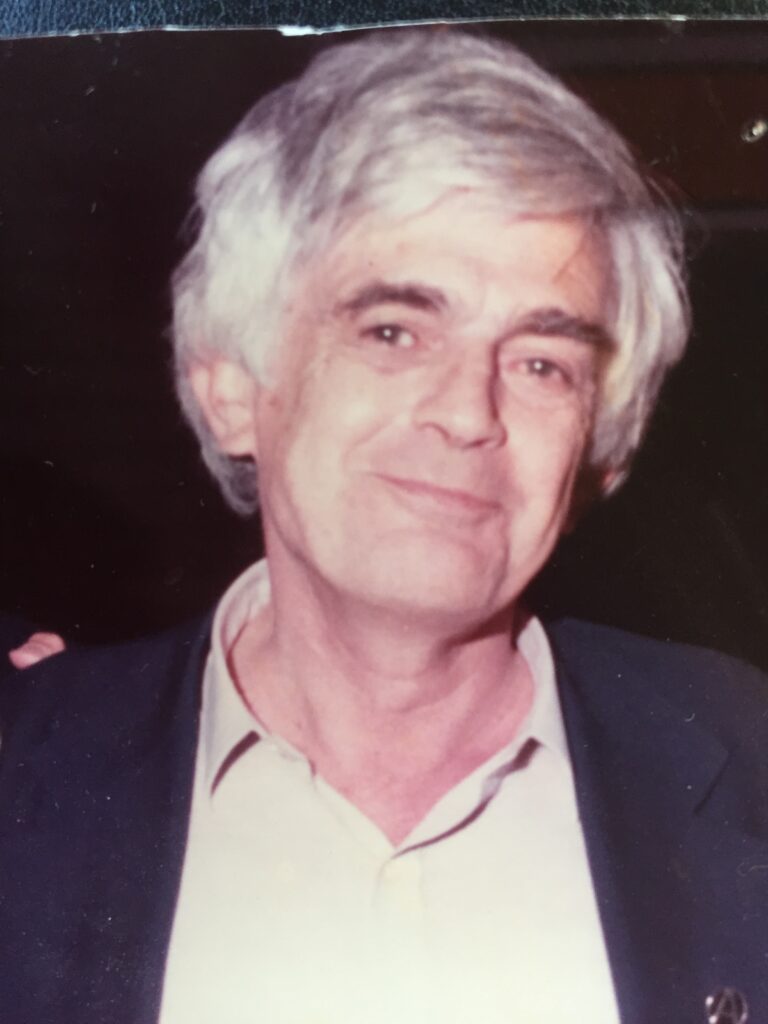
Bill Grono Remembered
Dennis Haskell
An important figure left the Western Australian literary community on Thursday, March 3rd when Bill Grono died, at the age of eighty-seven. Few writers can be so completely identified with WA, and he made a great contribution to its literature and education. William Basil Grono studied at the University of Western Australia, graduating with a Bachelor of Arts degree in 1966, winning the Convocation Prize in Arts in 1965, and in 1966 no less than the Tom Collins Prize, the Patricia Hackett Prize, and the F. W. Simpson Prize for English Verse. This, from a young man who left school at fifteen, and achieved his Leaving Certificate through part-time study at Leederville TAFE. Grono went on to achieve an MA from Syracuse University in New York State in 1974. There he received a two-year fellowship and studied under W. D. Snodgrass, the founder of American confessional poetry. Confessional poetry, though, was never Grono’s style; he was much more given to ironic social observation, like his favourite novelist, Charles Dickens. Near the end of his life Bill could still quote reams of Dickens, especially comic and satiric paragraphs. Professor John Diehl, Grono’s graduate teacher of Victorian Literature at Syracuse, said, ‘It soon became apparent to me that he knew twice as much about Charles Dickens as I did.’
Bill Grono was a renowned editor, and began this career at Claremont Teachers College, where he co-edited the weekly magazine, Chiron (named after the centaur who nurtured youth). He co-edited three textbooks for teaching English in schools. The poet and novelist Tracy Ryan recalls, ‘I owe more than one of my first publications, and my first job as an editor back in my twenties to Bill. Even before that, like others my age, I learned in school English classes from anthologies he had edited.’
Later, Grono served as Poetry Editor for the Fremantle Arts Review; with Bruce Bennett, edited Wide Domain: Western Australian Themes & Images (Angus & Robertson, 1979) for the WA Sesquicentenary; the Collected Poems of his long-time friend Dorothy Hewett (Fremantle Arts Centre Press, 1995); and the landmark volume Margins: A West Coast Selection 1829-1988 (Fremantle Arts Centre Press, 1988). Margins, published for the Bicentenary of European settlement, has become the fundamental text for nineteenth-century Western Australian poetry. In compiling their Fremantle Press Anthology of Western Australian Poetry (2017) John Kinsella and Tracy Ryan acknowledged ‘the ground-breaking work of William Grono’ and stated their ‘admiration and appreciation’. Kinsella dedicated the online anthology of WA writing he prepared for UWA to William Grono, and has described Bill as ‘part of Western Australian poetry’s essence’. In compiling Margins, Grono drew on his extensive collection of WA poetry, collected over many years; he donated the collection to the UWA Library, where it is held in the Special Collections.
Bill Grono published just one small collection of his own poetry, in the book shared with Nicholas Hasluck, On the Edge (Freshwater Bay Press, 1980). Peter Porter selected two poems from it for his Oxford Book of Modern Australian Verse (1996). Two poems from On the Edge are reprinted here, along with a response from David McCooey, who read them as an aspiring poet growing up in Perth.
Amongst Bill’s wide circle was Randolph Stow, as described by Nicholas Hasluck. After Stow went to live in England, Bill Grono was Stow’s main literary link with Western Australia; they spoke on the phone regularly until Stow’s death, and Grono contributed a great deal of information to Suzanne Falkiner for her biography, Mick: A Life of Randolph Stow (UWA Publishing, 2016). Stow was one of many contributors to a festschrift organised for Grono’s 70th birthday by his wife Janet, titled Gronoschrift. It includes poems and recollections, some published here, and photos of the young Bill Grono which show why Dorothy Hewett likened him to Gregory Peck. Other contributors included Bruce Bennett, Tom Hungerford, Peter Porter and various literary notables, many of them attesting to Bill’s famous wit and larrikin disrespect for authority. Some of the responders were past students or colleagues.
Bill Grono’s teaching experience was more extensive than that of anyone I’ve ever known. Bill taught in primary schools, high schools, Claremont Teachers College, and universities, including a long career at Edith Cowan University. Although universities are often focused on research and its impact, like many teachers Bill’s greatest impact was on the people he taught, read with, whose books he launched and whom he talked with, inimitably. He was one of the great raconteurs and conversationalists. It was his wife Janet who was keen on a move from Perth to Margaret River after he retired. Bill went reluctantly. They had both acted in amateur theatre when young, and after they attended a local production of Chekhov’s The Cherry Orchard, I asked him what it was like. He replied drily, ‘it’s about a bunch of lonely people being miserable in the country!’ Not an inaccurate summary but it does leave out a lot. Actually, surrounded by books and his stunning collection of Western Australian paintings, Bill always seemed much more cheerful than Chekhov’s characters. Good cheer was in his nature: Bruce Bennett predicted that ‘Bill will wisecrack his way to the grave’ and he just about did. His daughter Jane, told me that when the palliative care team visited from Margaret River Hospital they asked, ‘Is there anything you would like to do in your last weeks?’ Bill replied, ‘Yes, get rid of this rotten Government we have!’ When asked where he’d like to spend his last days, meaning home or hospital, Bill thought for a moment, then responded, ‘Mmm… Paris?’
Perhaps the sense of his personality and effect on others is best conveyed by an anecdote recounted by Roger Dixon, who studied with Bill at Claremont Teachers College. Bill was of the generation who had to do three months national service, and might have lain claim to being the worst soldier Australia ever trained:
‘Today we have naming of parts…‘
A Sten gun, I think. Private Grono, agog with disinterest, had already irritated Corporal Carol to the point where he had been ordered to do a lap of the parade ground holding his rifle at the ‘high port’.
He tottered back just as our next smoke-o was being called and sought the shade of one of the few trees where he was soon observed by the now relaxed but maliciously smiling Corporal to pull out a notebook and begin writing.
‘Feeling rested, Private Grono?’
No response.
‘What are you doing exactly?’
‘Writing. Exactly.’
‘Writing what?’
‘A novel.’
‘A novel, eh?’
‘A novel, yes.’
‘Would you mind telling us what it is called?’
‘No, I wouldn’t mind. It’s called Bastards I Have Met and you’re the first chapter.’
My memory of what happened next is hazy… Was it four or five more laps of holding your rifle above your head?
(Gronoschrift, 2004: 32-33)
A Reflection
David McCooey
When I was a young, would-be poet in Perth in the 1980s, discovering the work of Bill Grono was a key moment for me. I realised that Perth and Western Australia could be rich literary spaces, and that poems could be written within and about those spaces. The idea, still common back then, that Perth was marginal, suddenly disappeared for me.
(Selected from On the Edge, reprinted with the permission of his estate.)
The Way We Live Now
‘ … at the end of the earth / where existence is most easy. / Snow never falls there and no wild storms / disturb the sweetly flowing days; / only the soothing breezes of the West Wind / drift in each day from the Ocean, bearing / constant refreshment for the inhabitants …’
The Odyssey, Book IV
1
Here the talk’s of flowering annuals,
investments.
Ah, the richness of our soil!
Each morning automatic sprinklers bless
all that’s governable and nice;
sleek insects fatten on our ceaseless flowers;
glistening motors roam the land.
In our desirable brick-and-tiles
we dream of real estate.
2
Pursued by industrial suburbs—
‘the concrete evidence of our progress’—
the bush has fled to the hills. Those hills are alive
with machines, developers, dust. Beyond,
our country lies, wide
and open.
We are, we often feel, living
on the edge of something good.
3
Nothing disturbs us.
Winds from Africa and Indian waves
bear each day to our long white shore
only what we most admire: fashions,
technology, and rich strangers as neat as
beetles who smile at our
simple friendliness.
4
Yes, we like it here.
Sometimes the shrewdest of us find the time,
after the gardening, before television,
sipping beer on enclosed verandahs,
to speculate on the future.
The Oleander
Each morning lately I
have seen the warm east wind ripple and shift
our long-limbed uplifted oleander so that the high
red flowers (blood-bright, dark) tremble, lift
and sway in light. Red
and high, they would with their persistent blaze
wave all summer. Yet, burnt, diminished, brown, and dead,
some fall each day to where my daughter plays
pale in the grassy shade.
This morning she turned two and took with mild
surprise kisses, clothes, some toys, a ball, a hand-made
garden swing (O my little light child,
you shrieked and flew as high,
you thought, as all the trees and sky, hung—
lovely, frail—until backward through the flowing air to my
aching outstretched arms and heart you swung).
Now she gravely hugs
her birthday doll and lies it, limbs askew,
on a bed she’s made of some badly-folded bunny rugs;
and now, singing a song I never knew,
she strokes its glistening hair.
It’s eight o’clock. The flowers blaze in their scent.
The wind as warm as blood or breath moves slowly west to where
pale in the light, a murderer, intent
on breathing, stands, falls
into shade, hangs trembling, hanged. The wind as it flows
sways and shifts with a mortal sound like a sigh, and still
beneath this lively tree, these blazing flowers
(ah, dark heartsblood red!),
dead petals fall. Each morning takes its toll.
Nothing frail can stay. A body swings inside my head.
My child breathes life into her rigid doll.
Two Poems Dedicated to William Grono
Sea Chest
i.m. Bill Grono
John Kinsella
Bearing a sea chest inland
you know we won’t be there
but leave it on the verandah.
A sea chest full of copies of poems
from Swan River Colony newspapers.
It is up to me to work out whether
each poem can speak to now,
or is best reverted to its original
fading ink and deteriorating paper.
Never one for keeping a secret,
you were happy for next generations
to read and reinterpret, understand
better or lose something in the process.
Swings and roundabouts. And on
an overcast day not far from the river
as it curved past the university
twenty-five years prior, you said
something like, Well, see you somewhere
soon… which was like a guarantee
that the sun would appear again
over the variegated waters,
and that a future would
inevitably bring us together
again—maybe in one of those
haunts where poetry was a métier,
where a lyrical anecdote might
take shape. Did I tell you about?
Bearing a sea chest inland
you knew we wouldn’t be there
but left it on the verandah—
an argosy of many histories,
some conflicted, some traumatic,
and others indifferent to how
any hereafter might look upon
them. Anecdotes in retrospect—
made in the moment.
What’s the Gossip?
i.m. William Grono, 1934-2022
Dennis Haskell
Bill, the phone call on Wednesday late,
despite your rasping voice
and cancer-thickened lungs,
put no flea in suddenness’ ear
as I said we’d be down to see you;
‘I might not be here,’ you replied
as if you might saunter to Pemberton or Paris,
wry as ever, self-sardonic, open and honest.
‘You’d better be!’ I quipped,
‘We’re not coming for nothing!’
but on Thursday morning early
you joined the unknowable dead,
a great raconteur reduced
to silence. Soon you will be
down to earth, literally,
who loved puns, people and talk
and all that words might imagine.
When I last saw you, you asked
straightaway, ‘What’s the gossip?’
but the gossips you knew have
already gone. Now you chat with them
again, recite chunks of Dickens,
Louis Simpson, poets you knew.
By now you know if there is
more to us than flesh, bone
and arteries—or else you are
where the question of knowing
no longer exists, and all the joy
you shared in lines and rhyme and mirth
exists only in our transient, fragile memories.
Contributors
Lucy Dougan’s books include Memory Shell (5 Islands Press), White Clay (Giramondo), Meanderthals (Web del Sol) and The Guardians (Giramondo), which won the Western Australian Premier’s Book Award for poetry. With Tim Dolin, she is co-editor of The Collected Poems of Fay Zwicky (UWAP, 2017).
Emeritus Professor Dennis Haskell is the author of nine collections of poetry, the most recent And Yet… (WA Poets Publishing, 2020), plus fourteen volumes of literary scholarship and criticism. He was Co-editor of Westerly magazine from 1985-2009 and is a Senior Honorary Research Fellow at The University of Western Australia.
In addition to books of verse, Nicholas Hasluck has published fifteen works of fiction. A former Chair of the Literature Board of the Australia Council, he has also served as Chair of the Commonwealth Writers Prize.
John Kinsella is the author of over forty books. His many awards include the the Christopher Brennan Award for Lifetime Achievement in Poetry, the Australian Prime Minister’s Literary Award for Poetry and the Western Australian Premier’s Award for Poetry (three times). His latest release is The Ascension of Sheep, Collected Poems Volume One (1980-2005) (UWAP 2022). He is a a Fellow of Churchill College, Cambridge University, and Professor of Literature and Environment at Curtin University, Western Australia. He lives on Ballardong Noongar land at Jam Tree Gully in the Western Australian wheatbelt.
David McCooey is an award-winning poet, critic and editor. He lived in Perth from 1970-1990. Since 1995 he has lived in Geelong, where he is a Professor of Writing and Literature at Deakin University.
Partners




1 thought on “Vale William Grono (1934-2022)”
You must be logged in to post a comment.
Comments are closed.