Review of ‘Monument’ by Bonny Cassidy
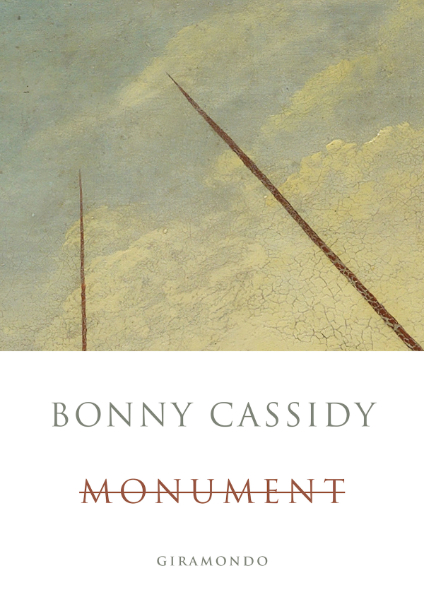
Cassidy, Bonny. Monument. Western Sydney: Giramondo Publishing, 2024.
RRP: $32.95, 288pp, ISBN: 9781922725899.
Aden Curran
The re-examination of our collective history: Monument and truth-telling
It was a funny little popular history book that first gave me the feeling of awe which Jo Jones has described as ‘the sublimity of the past’ (22). The book was A Time Traveller’s Guide to Medieval England, by Ian Mortimer. Its premise was to write about medieval England as if it were a Lonely Planet-style travel guide, giving the reader ‘travel tips’ such as what sort of food you might expect locals to serve, or how to properly greet someone in the street. Mortimer’s greatest trick was perhaps to write in present tense. Never had I felt so strongly that the figures ploughing fields in illuminated manuscripts were as infinitely, unknowably and mysteriously complex as any person in my life today.
Bonny Cassidy’s Monument once again evoked this feeling for me—of the dizzying complexity of the past. Oscillating through the genres of poetry, microhistory, memoir, travel writing and speculative prose, this book traces a finger along fractures in the history of colonial settlement in Tasmania. In using such a wide range of approaches, Cassidy is able to come at the history from many different angles, giving a complex account of the resonances and remnants present in our lives. She writes with a revealing precision on the layers of feeling we have around monuments—perhaps as the embodiments of our collective memory, or perhaps as those figures or moments elevated by an official national narrative. This precision reflects her experience as a poet, having previously published three collections, as well her being a widely published essayist and critic: she pulls together both the poetic and the critical deftly.
Cassidy’s work considers Tasmania’s genocidal colonial past and her own family history; she reckons with a genealogy of settlers and migrants who, she writes, ‘walk in the ruins that invasion has created for them’ (47). As she recounts this invasion, and the Palawa resistance to it during the 1820s in a period known as the Black War, she describes the George Augustus Robinson-implemented scheme to create peace by convincing the Palawa to be resettled at a place on Flinders Island. That place came to be known as the Wybalenna settlement. There, hundreds would die from disease and poor living conditions, never being allowed to return to their home on the mainland. Cassidy brings the sweeping horror of this dark history into stark relief with her settler family history in poignant moments throughout the book, such as this:
In 1842, as my great-great-great-grandfathers snore beside the Derwent River, four Palawa people are found living on the west coast of Van Diemen’s Land. They include Oyster Bay people from the Coal Valley—the Country behind piyura kitina, Risdon Cove.
They are taken to Wybalenna. (197)
As I read Monument I became very interested in how it deals in multiplicities. Cassidy carries much throughout the book without necessarily offering resolution. Instead, she seems to leave the past before us, ready for interpretation, without bearing down on the reader. Hers is a truth of impressions, as interested in families and their emotions as in the capital-H History that contextualises them. It is an approach to truth telling, and to the ethical obligation we must navigate in thinking about our colonial past: a theme to which Cassidy returns throughout the book. An array of lives, emotions and stories are laid before the reader like a curation of objects scattered on a vast table—truth telling as a view of the historical sublime.
Which isn’t at all to minimise the necessary political element of truth telling. Cassidy certainly doesn’t shy away from the political dimensions of her work, writing with sensitivity to her position as a white writer while standing staunchly for reconciliation. Weaved through stories of her own family history are those of two Palawa men from the 1800s, Tunnerminnerwait and Maulboyheener, and their dealings with Robinson as they lived through the attempted genocide of their people. Cassidy writes, ‘Their story isn’t mine, but I stand by it’ (13). In The Postcolonial Eye, Ravenscroft asks how ‘might a settler not read? […] How not to fill in the gaps or slide over them in our haste at interpretation?’ (2). Cassidy doesn’t deploy speculation here, where it would be inappropriate, and is careful in her attempts to not tell a story that is not hers to tell while still giving Tunnerminnerwait and Maulboyheener presence. She does, however, wonder about the emotional lives of her own forebears in her writing, largely by collecting historical facts and asking questions of the assemblage before her, as in the passage:
To quit a region, like Herman Anders quit the Wimmera Mallee, is a euphemism as emotionally opaque as taking up land. What is felt when a settler leaves the toxic society they have normalised or the soil they have abused for decades? What do they miss, regret, or relieve? (98)
To speculate in this grounded way opens up history, leaving the reader wondering how they might answer these questions while at the same time pointedly not demanding an immediate answer. In these narrative places I felt as though I could step inside the past. This level of emotional entanglement with history makes Cassidy’s account of the staggering loss suffered by the Palawa people following invasion difficult, and important, to read.
Cassidy accomplishes something very special, and timely, in this book. In resisting presenting a neat view of the past, she accomplishes an emotional, precise, sometimes devastating, and always intriguing work. Monument is a complex contribution to the project of truth telling about Australia’s colonial past, and a sweeping insight into the histories of our colonial past, understood on a familial scale.
Works Cited
Jones, Jo. Falling Backwards: Australian historical fiction and the History Wars. UWA Publishing, 2018.
Mortimer, Ian. A Time Traveller’s Guide to Medieval England. London: Vintage Books, 2009.
Ravenscroft, Alison. The Postcolonial Eye: white Australian desire and the visual field of race. Taylor & Francis Group, 2012.
Aden Curran (he/him) is a writer and PhD student living in Boorloo/Perth on Whadjuk Noongar Country. He is interested in exploring through his writing ideas around ecology, place, community, difference and social justice. He has been published in Westerly and Pulch. You might one day bump into him somewhere along the Bibbulmun Track.
Partners