
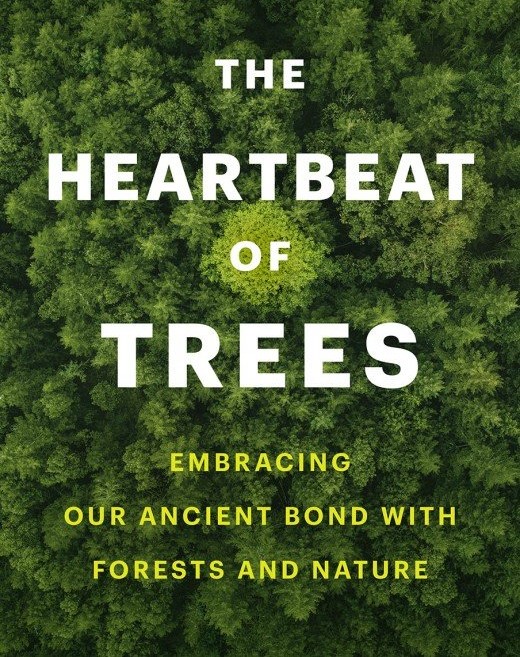
Review of ‘The Heartbeat of Trees: embracing our ancient bond with forests and nature’ by Peter Wohlleben
Wohlleben, Peter. (2021). The Heartbeat of Trees: embracing our ancient bond with forests and nature. Translated by Jane Billinghurst, Carlton: Black Inc, 2021. RRP: $29.99, 272 pages, ISBN: 9781760642648.
Rachel Watts
‘Don’t worry, our connection with nature is not so diminished that our only hope of long-term survival lies with modern technology.’ (Wohlleben 2)
Peter Wohlleben’s The Heartbeat of Trees is resolutely optimistic. This fourth book by the German author focuses not on the inner world of trees and animals, like his earlier works, but on the relationships between nature and human society. He starts by describing physiological connections between the forest and the human body, such as the evolution of the human eye, and the ability to see the colour green, which is limited even among mammals and probably helps primates to recognise ripe fruit. The human sense of smell and hearing, wellbeing and health and the desire to make homes and industry are all sites of interaction with the forest too. Wohlleben observes how these relationships are defined by cocreation, cohabitation and exploitation.
Wohlleben’s writing style is light and conversational. This works in his earlier book The Hidden Life of Trees, and also in his discussion of how we see and hear the forest in this more recent offering. In these chapters his chatty tone has a sense of wonder about it, something from childhood, and it’s easy to be absorbed in his fascination with his subject.
Even though plants are the primary producers of food on this planet, so integral to our evolution that they have informed how our eyes work, we remain remarkably resistant to seeing how they themselves thrive as parts of complex communities. Some of Wohlleben’s most interesting writing relates to how trees and plants function: from the ways they experience pain, to the way they process light. On the latter, he suggests abilities akin to sight, through descriptions of how plants grow and use light. Trees that can see? Wohlleben seems taken by the idea, and this is where his writing really shines: when he is exploring the surprising abilities of the plant world. He identifies that the ways in which we relate to, think about and refer to plants and forests are limited, and describes how this has affected our relationship with the planet. We would not accept the idea of a butcher being in the business of caring for animals, for example. But the role of a forester, Wohlleben’s former profession, is more like a butcher than a vet: ‘Foresters describe “thinning” as caring for the trees, when what it really means is that up to 20 per cent of the trees in a stand are cut down (that is to say, killed) and then processed’ (107). A recent drive to get back to nature, Wohlleben says, is something of a double-edged sword. While it means more people are present and risk damaging the landscapes of the forest, it can only help humans become more aware of the need to respect the things that live there, out there, in nature.
It is when Wohlleben delves into the fight to save and protect various forests from industry and deforestation that his conversational tone feels at best a distraction, and at worst an obfuscation. These chapters seem to read more like a travel journal than explorations of the contested sites of nature, culture and industry that he describes. In one scene, protesters drop from tree canopies on ziplines and request he help raise wood for their protest platforms before they would answer any questions—but the content of the discussion is missing from the story he recounts. We get the barest details of the nature of their protest, the tone of their efforts, or even of their demeanour as they try to outlast a powerful legacy industry: coal. When we talk about our relationship to trees, what about the people who risk everything to protect them?
Writing from Germany, Wohlleben describes the nature of the forests he is familiar with, telling us that there is no old-growth forest in his native country. The forest that is considered ‘old’ is only a few hundred years old:
It’s easy to see signs of the reforestation programs of previous decades. And, even if large numbers of oaks and other deciduous trees have not been exploited for more than a century, another four hundred years or so probably needs to pass before Białowieża can truly be considered an old-growth forest. (221)
These descriptions are curious when read from Whadjuk Noongar country, as there are so many differences in the composition of the bush, the nature of the climate and the way we interact with the land. Despite this, the differences also reinforce the fact that forests have been destroyed in the name of progress everywhere. There is a vast absence in Wohlleben’s account of the political and colonial power of this destruction—and the way the environmental and social damage done by colonisation is interlinked. Wohlleben estimates that a forest can’t be considered recovered from human intervention until a generation has passed for the trees that live within it. For some species that might be 500 years. This seems impossible while the extractive process that colonisation brings with it is only interested in protecting dollars, not forests as communities, filled with vibrant and valuable living beings. On the timescale of Indigenous custodianship of this boodja, 500 years is a blink of an eye. But in Western, colonial, terms, it’s forever.
Wohlleben doesn’t linger on Indigenous relationships with Country, focused as he is on his homeland, but he does reference one First Nations fight in Canada as the closest relationship between the forest and people that he’d ever seen. It’s a shame that it was only deemed worthy of one chapter:
Meanwhile, what is happening in the Kwiakah’s forest are cosmetic corrections that affect only the aesthetics of the forest. On the boat trip back, one of the foresters pointed to the slope on the opposite shore. ‘You can only see 15 percent of the clear-cut,’ he said proudly. The rest was so cleverly done that it disappeared behind the hills in front of it. What tourists see is nothing more than a green backdrop that imitates old growth. (213)
Despite all this, throughout the book, Wohlleben is resolutely optimistic. Perhaps this optimism leads him to shy away from shades of grey that speak to the damage wrought in Europe and globally. But he ends on a singular note: it’s not too late. ‘We are in this world together,’ he says, ‘as we always have been, and we in a position to make sure it stays that way for a long time to come, because this is the world we were made for. It is by no means too late to protect nature. We are too tightly bound to it’ (236). Optimism isn’t the worst thing in the world, right now. Let’s hope he’s right.
Rachel Watts is a writer of literary and speculative fiction and short, creative non-fiction. Her writing has been published by Westerly, Island, Kill Your Darlings, The Big Issue and more. Her manuscript ‘In the Morning I Rise’ was shortlisted for the 2020 Penguin Literary Prize.
Partners